Texas Land Loan Calculator: How to Estimate Your Ranch or Farm Payment Before You Apply
If you are shopping for Texas acreage, a loan calculator can help you plan. But many popular calculators are built around a typical home purchase, and land purchases can involve different assumptions.
This guide explains the inputs that matter on a land purchase, shows hypothetical math so you can see how each input moves a payment, and describes how to run your own scenarios before talking with a lender.
Quick answer: To estimate a loan payment, you need the purchase price, down payment, interest rate, loan term, and an estimate of annual property taxes and insurance. Change one input at a time and watch what moves.
Why a Standard Mortgage Calculator May Not Fit a Land Purchase
A calculator is only as accurate as the assumptions you enter. Defaults built for a house may not match a rural property. Consider:
- Down payment. Requirements vary by lender, property type, intended use, and borrower profile. Land and rural purchases may call for a different down payment than a home purchase, so test a range rather than accept a default.
- Term and structure. Rural loans may be structured in different ways, including fixed-rate, variable-rate, or other repayment structures. Available options depend on the lender and program.
- Property taxes. Land with an agricultural valuation may be taxed differently than other property. A default tax rate may not reflect your situation.
- Improvements. Raw land, land with a barn or shop, and land with a home are different scenarios, even on the same acreage.
The 5 Inputs That Drive an Estimated Land Loan Payment
1. Purchase price
Use the actual contract price or a realistic range for the tract, not a statewide average.
2. Down payment
The down payment changes the amount financed. Run the same property at several down payment amounts and compare. Any range shown in this article or in a calculator is a planning example, not a lender requirement or recommendation.
3. Interest rate
Rates change and vary by lender, program, and borrower. If you have a quote from a lender, use it. If not, test a low, middle, and high case. Note that an interest rate and the annual percentage rate (APR) of a loan are not the same thing; the APR reflects certain costs and is disclosed by the lender on actual loan offers.
4. Loan term
A shorter amortization generally means a higher payment and less total interest. A longer one generally lowers the payment and increases total interest. The right choice depends on your own cash flow and goals.
5. Taxes and insurance
These are not part of principal and interest, but they are part of the cost of owning land. Include a realistic annual estimate. If a property might receive an agricultural valuation, ask a qualified tax professional how it applies to your situation. See our overview of the Texas ag exemption. This is not tax advice.
Hypothetical Payment Math (Illustration Only)
Hypothetical example: 7.50% interest rate, 25% down payment, principal and interest only.
| Hypothetical purchase price | Amount financed | 15-year term | 20-year term | 30-year term |
|---|---|---|---|---|
| $200,000 | $150,000 | ~$1,391 | ~$1,208 | ~$1,049 |
| $500,000 | $375,000 | ~$3,476 | ~$3,021 | ~$2,622 |
| $1,000,000 | $750,000 | ~$6,953 | ~$6,042 | ~$5,244 |
What the math shows
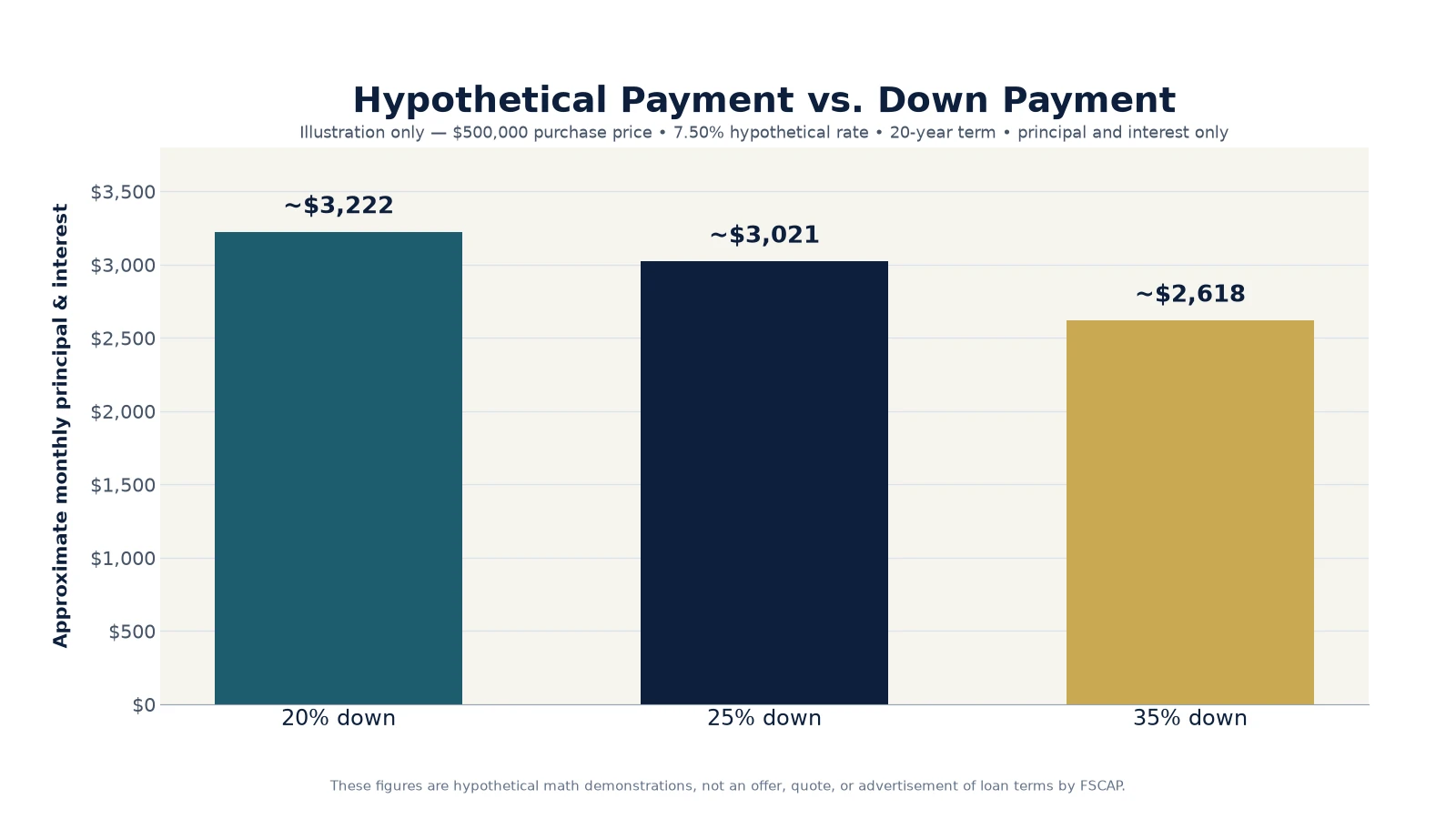
The amount financed drives the payment. Same hypothetical $500,000 price, 7.50% hypothetical rate, 20-year term:
| Hypothetical down payment | Amount financed | Approx. monthly P&I |
|---|---|---|
| 20% | $400,000 | ~$3,222 |
| 25% | $375,000 | ~$3,021 |
| 35% | $325,000 | ~$2,618 |
Small rate changes move the payment. On a hypothetical $375,000 balance over 20 years, a one-point change in the hypothetical rate changes the payment by roughly $225 to $235 a month:
| Hypothetical rate | Approx. monthly P&I |
|---|---|
| 6.50% | ~$2,796 |
| 7.50% | ~$3,021 |
| 8.50% | ~$3,254 |
Term trades monthly payment for total interest. On that same $375,000 balance at 7.50%, a 20-year amortization totals about $350,000 in interest and a 30-year amortization totals about $569,000, before taxes, insurance, and fees.
Extra principal payments can change how quickly a balance is paid down. Prepayment terms vary by loan, so confirm any lender's prepayment and payment-handling rules before changing a payment plan.
How to Use the FSCAP Calculator for a Land Purchase
FSCAP's free land loan calculator Texas is an educational planning tool. For a land purchase you can:
- Enter a price, planning down payment, assumed rate, and term.
- Use the rural and land planning inputs, including acreage and an editable planning down-payment range. These are not lender requirements, recommendations, quotes, or approval criteria.
- Add estimated property taxes and insurance.
- Compare fixed-rate, interest-only, and balloon repayment assumptions.
- Compare up to three scenarios side by side.
- Model extra principal payments and review the amortization schedule.
- Export or print your assumptions to bring to a conversation with a lender.
The calculator provides estimates from the assumptions you enter. It is not an offer, quote, approval, rate lock, or commitment to lend.
Raw Land, Improved Land, and Barndominiums
The same acreage can be a different loan scenario depending on what is on it and how you plan to use it.
- Raw or unimproved land. Lenders may consider access, utilities, survey, and intended use.
- Land with improvements such as barns, shops, fencing, or water. Improvements may affect the appraisal and structure.
- Land with a home or barndominium. A barndominium combines residential and shop or agricultural space, which can affect how a property is appraised and which financing structure may fit. A build may involve a construction phase before permanent financing.
If a barndominium is part of your plan, consider running separate calculator scenarios for the land purchase and the total project cost, then discuss structure with a lender.
Costs a Payment Estimate Does Not Show
Plan for items outside principal and interest, such as:
- Closing costs, appraisal, survey, and title
- Property taxes and insurance
- Water, well, septic, electric, and road or access improvements
- Fencing, equipment, and maintenance
- Cash reserves
Frequently Asked Questions
How do I estimate a land loan payment in Texas?
Subtract your down payment from the price to get the amount financed, then enter that amount with an interest rate and term into a loan calculator. Add estimated property taxes and insurance for a fuller picture of monthly cost. Test several rates and terms.
How much down payment is needed for a Texas land loan?
It varies by lender, program, property, intended use, and borrower profile. A calculator lets you test different down payment amounts before you speak with a lender.
Is a land loan calculator the same as a mortgage calculator?
The payment math is the same. The assumptions you enter, such as down payment, term, and taxes, may differ for land.
Can a calculator tell me if I will be approved?
No. A calculator estimates a payment from the numbers you enter. Approval depends on credit, income, assets, the property, appraisal, title, and underwriting guidelines.
Do property taxes work differently on rural land?
They can. Land with an agricultural valuation may be taxed differently than other property. Ask a qualified tax professional about your specific property.
Run Your Numbers, Then Talk with a Loan Officer
Open FSCAP's calculator, test your scenarios, and bring the results to a conversation about your plans.
Talk with a Loan Officer or call (888) 484-1256.
Dan Cunyus | NMLS# 218025 | First Source Capital Mortgage, Inc. | NMLS# 217672 | Lubbock, Texas
This article is for general educational purposes only. It is not an offer or advertisement of specific loan terms, a quote, a commitment to lend, or financial, legal, or tax advice. Examples use hypothetical figures that do not reflect current or future rates or FSCAP pricing. Actual rates, APRs, payments, costs, and eligibility depend on credit, income, assets, the property, appraisal, title, and underwriting guidelines. All loans subject to credit approval, property appraisal, and underwriting guidelines. Consult a qualified tax professional about property tax valuations. Verify licensing at NMLS Consumer Access.
Equal Housing Lender